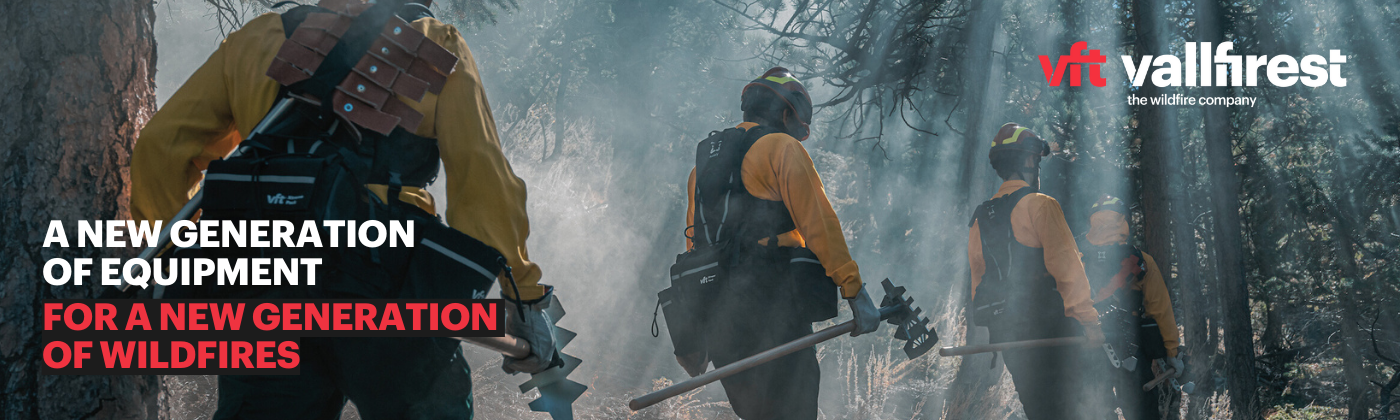
"Empowering Excellence, Uniting Expertise: Igniting Tomorrow's Fire Practitioners"
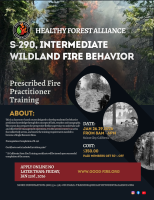
Fire Behavior S-290, Intermediate Wildland Fire Behavior (Blended)
COURSE DESCRIPTION:
This is a skills focused course designed to prepare the developing fireline supervisor to undertake safe and effective fire management operations. It is the second course in a series that collectively serves to develop fire behavior prediction knowledge and skills. The course will train students how to make a thorough, timely assessment of the fire environment and to anticipate changes in fire behavior based on changes in and/or alignment of the fuels, weather, and topography. Students will then practice using this information to support their decision-making and risk management on the fireline.
This BLENDED course is designed to introduce students to the characteristics and interactions of the wildland fire environment (fuels, weather, and topography) that affect wildland fire behavior for safety purposes. Students will also be shown how such information can be applied.
The course is a blended training combining an Online Training (OLT) component (22 hours) and an Instructor-led Training (ILT) component (16 hours).
ONLINE TRAINING COMPONENT:
The focus of the online training is to teach knowledge and concepts. The course lessons build upon the basics in S-190, and provide more detailed information on fuels, weather, and topography. They also provide a basis for analyzing variables and understanding how different interactions affect wildland fire behavior for firefighter safety. The online training will take approximately 22 hours to complete. Your progress will be saved as you move along.
Students are required to complete the online component of the course and pass the assessment prior to taking the ILT portion. At the conclusion on the online component, student receive a Memo of Completion of the online component. The memo is proof of your successful completion of the online component and must be provided to the instructor prior to the instructor-led portion of the course.
INSTRUCTOR-LED TRAINING COMPONENT:
The ILT will reinforce the content learned online and provide opportunities to apply this knowledge to real-world scenarios and practical exercises.
Upon successful completion of the Instructor-led portion, the lead instructor will issue a NWCG Training Course Completion Certificate.
OBJECTIVES:
By the end of this course, you will be able to:
- Identify and describe the attributes of the fire environment that influence wildland fire behavior.
- Acquire, interpret, and communicate the characteristics of the fire environment.
- Recognize the critical interactions between the elements of the fire environment and their effects on wildland fire behavior.
- Anticipate changes in fire behavior that will impact on-the-ground decision-making and risk management.
TARGET GROUP:
Personnel desiring to be qualified as any Single Resource Boss or Fire Effects Monitor (FEMO).
PREREQUISITE QUALFICATIONS & TRAINING:
Successful completion of S-190, Introduction to Wildland Fire Behavior.
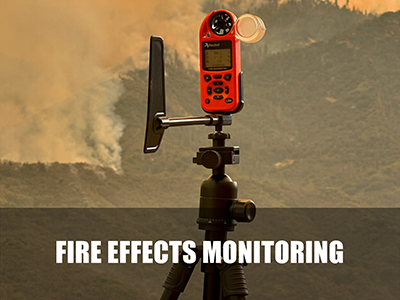
SCHEDULE FOR S-290, INTERMEDIATE WILDLAND FIRE BEHAVIOR (Blended)
DAY 1
0800 - 0830
Welcome, Introductions, Course Overview
0800 - 0830
0830 - 0900
Unit 1: The Fire Continuum
- Define fundamental terms related to fire potential, fire behavior, and fire effects.
- Identify factors that influence fire potential, fire behavior, and fire effects.
- Develop the ability to describe observed fire behavior and fire effects.
1000 - 1015
Break
1000 - 1015
1015 - 1200
Unit 2: Topography
- Define the fundamental terms related to topography and their potential effects on fire behavior.
- Use a topographic map to identify and communicate relevant information including critical topographic features, measurements, and potential fire behavior.
1200 - 1300
Lunch
1200 - 1300
1300 - 1430
Unit 3: Fuels
- Define the fundamental terms related to fuels and their potential effects on fire behavior.
- Identify the relationship between fuel moisture and fire behavior.
- Develop the ability to estimate fuel loading and fire behavior fuel models.
1430 - 1445
Break
1430 - 1445
1430 - 1445
Unit 4: Weather Fundamentals
- Define the fundamental terms related to fire weather and their potential effect on fire behavior.
- Describe the processes that influence the moisture of the air.
1600 - 1700
Unit 5: Air Movement
- Define the processes that influence the movement of air.
- Recognize the influences of global weather patterns and surface features on local air movement.
1600 - 1700
1600 - 1700
Unit 6: Gathering and Communicating Fire Environment Information
- Recognize visual indicators of atmospheric conditions that can influence fire behavior.
- Demonstrate an ability to read and interpret fire weather forecasts.
- Locate fire weather observations and forecasts.
- Develop the ability to measure, document, and communicate weather characteristics and trends.
1730 - 1800
End-of-Day Discussion and Review
1730 - 1800
DAY 2
0800 - 0930
Unit 7: Regional Patterns and Resource
- Review Geographic Area Predictive Services resources and patterns (i.e., what fire environment influencers or indicators) and apply locally.
0800 - 0930
0930 - 0945
Break
0945 - 1200
Unit 8: Anticipating Changes in Fire Behavior
- Recognize the synergistic effects on fire behavior when the elements of the fire environment align.
- Anticipate the impact of changes in the fire environment on fire behavior.
- Demonstrate an ability to anticipate fire behavior using fire environment inputs and reference
tables.
0945 - 1200
1200 - 1300
Lunch (field)
1015 - 1200
Unit 9: Mindset for Operating in a Complex Environment
- Recognize the influence of mindset and attitude on decision-making and risk management.
- Explore concepts and resources to help improve your mindset when operating in a complex environment.
1015 - 1200
1430 - 1445
Break
1300 - 1430
Unit 10: Fireline Decision-Making and Risk Management
- Identify fire behavior decision-making resources and recognize their applications and limitations.
- Recognize the importance of the relationship between safe separation distance and escape time when it comes to managing risk and entrapment avoidance.
- Demonstrate the ability to use knowledge of the fire environment and modeling tools to estimate and anticipate fire behavior to aid in fireline decision-making and risk management.
1300 - 1430
1730 - 1800
After Action Review
UPCOMING TRAINING
Please Support Our Corporate Members
HELPING LANDOWNERS PROMOTE HEALTHY FORESTS USING "GOOD FIRE"
how you can help
LEARN MORE ABOUT PRESCRIBED FIRE AND HOW IT CAN BE USED TO PROMOTE HEALTHY FORESTS
FROM OUR BLOG
🔥 Small Teams, Big Impact: The Rise of Micro Prescribed Burn Associations Across California,...
“So You’ve Masticated Your Land for Fire Safety… Now What?” Across California, thousands of...
🔥 The Do’s and Don’ts of Pile Burning for Property Owners in California When used correctly, pile...
Please Support Our Corporate Members